How to Grill Steak: Powerful Chef Tips for Ribeye, Tomahawk, and More
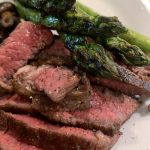
Want to know how to grill steak properly? Start with salt, heat, patience, and a thermometer. From ribeye to tomahawk, a few simple techniques create a beautifully crusted, juicy steak every time.
Steak season arrives every year and suddenly everyone becomes very confident around a grill. Tongs start clicking. Thermometers disappear. Someone announces they can tell doneness by “feel.” We love confidence, but good quality beef (from our fave Fore Quarter Butcher Shop) deserves a better plan.
As Red Seal chefs, we have grilled everything from weeknight striploins to giant tomahawks that looked like they belonged in a Flintstones episode. Last Father’s Day we grilled a tomahawk that was honestly bigger than our youngest kid’s head. Equal parts impressive and ridiculous. Everyone gathered around the cutting board waiting for the big reveal. Check out the Notes below for a solid step-by-step on How to Cook a Tomahawk steak.
The biggest lesson from that grill steak dinner had nothing to do with grill marks or temperatures. Resting that steak with butter made all the difference.
If you want to know how to grill steak without ruining expensive beef, we’ve got you.
How to Grill Steak Properly
The best way to grill steak is simple. Remove it from the fridge, season generously with kosher salt, cook over high heat, monitor the internal temperature, and rest before slicing.
That sounds straightforward because it is. Steak does not need motivational speeches, six spice blends, or constant flipping.
Start by taking the steak out of the refrigerator about 30 to 45 minutes before grilling. This takes some of the chill off and promotes more even cooking.
Pat the steak dry with paper towel. Moisture is the enemy of browning.
Season generously with kosher salt. We hold back on pepper until the end because pepper over intense heat can scorch and become bitter.
Preheat your grill well. Hot grills create crust. Lukewarm grills create disappointment.
The Science Behind Great Grilled Steak
Great grilled steak comes down to moisture control, heat, and carryover cooking.
When steak hits a hot grill, the surface browns through the Maillard reaction. Hundreds of flavour compounds develop, creating that savoury crust everyone loves.
Moisture slows browning, which is why drying the steak matters.
When you grill steak, remember that carryover cooking matters too. Steak continues cooking after leaving the grill. The residual heat keeps moving inward and can raise the internal temperature by several degrees.
That means if you pull a steak exactly at your final target temperature, you probably overshot it.
- Prep Time: 10 Minutes
- Cook Time: 10 Minutes + Resting
- Total Time: 20 Minutes
- Yield: 2-4 Servings 1x
Ingredients
- 2 steaks, ribeye, striploin, or sirloin, about 1 to 1 1/2 inches thick
- kosher salt
- freshly cracked black pepper (for serving)
- 1 tbsp olive oil or neutral oil
- 2 tbsp butter
- fresh thyme or rosemary, optional
- Sea salt, such as this one, for serving
Instructions
- Remove steak from the refrigerator 30 to 45 minutes before cooking.
- Pat dry thoroughly.
- Season liberally with kosher salt.
- Drizzle with oil (even if your steak has a good amount of fat, this will help with heat conduction and attract smoke).
- Preheat grill to high heat and create a two-zone setup with a hot side and cooler side.
- Grill steaks over direct heat.
- Cook approximately 3 to 4 minutes per side for a 1-inch steak, depending on thickness.
- Move to indirect heat if needed (for real thick steaks, such as a tomahawk) to finish cooking.
- Remove steak 5°F below desired final temperature (see guidelines below)
- Top with butter and herbs, if desired.
- Rest, on a carving board, uncovered, for 5 to 10 minutes.
- Crack fresh pepper overtop after resting.
- Slice against the grain and serve, garnished with a little sprinkle of sea salt.
Notes
Steak Temperatures Matter
Use a thermometer, or get a lot of practice using your senses.
Approximate pull temperatures:
- Rare: remove at 120°F, finishes around 125°F
- Medium rare: remove at 125°F, finishes around 130°F to 135°F
- Medium: remove at 135°F, finishes around 140°F to 145°F. A key indicator to watch for here is blood rising to the surface of the steak. Take it off at this point for it to rest up to a medium.
- Medium well: remove at 145°F, finishes around 150°F
- Well done: respectfully, we still love you
Thicker steaks benefit enormously from a thermometer.
How to Grill a Tomahawk Steak
- A tomahawk steak typically weighs 2 to 3 lbs and comfortably serves 2 to 4 people, depending on appetites and side dishes.
- Remove from the fridge 45 to 60 minutes before grilling and season generously with kosher salt.
- Because tomahawks are very thick, start them over indirect heat at about 375°F with the lid closed until the internal temperature reaches 115°F to 120°F for medium rare. This usually takes 30 to 45 minutes depending on thickness.
- Finish over direct high heat for 1 to 2 minutes per side to build a deep crust and grill marks.
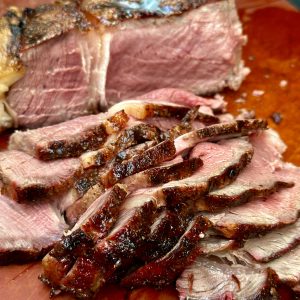
- Remove from the grill, top with butter, and rest 10 to 15 minutes before slicing.
- Slice the meat away from the bone, then cut against the grain into thick slices and finish with flaky salt and cracked pepper.
How to Get Grill Marks
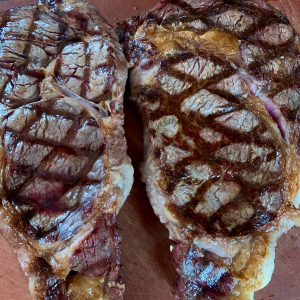
Good grill marks come from contact and patience. And the Red Seal Chef secret of ’10 & 2′.
Place the steak on a hot grill and leave it alone for about two minutes, with the ‘top’ of the steak angled towards the 10 o’clock mark.
Rotate the steak 45 degrees (towards ‘2 o’clock’) without flipping. Leave for another two minutes.
Flip and continue to cook to desired doneness.
Do not slide it around. Do not repeatedly peek underneath. Grill marks require commitment.
Notes for Different Steak Cuts
Ribeye
Ribeye contains beautiful marbling and cooks quickly over direct heat. Medium-high to high heat works well, just watch out for flare-ups. You can definitely continue on your indirect side.
Striploin
Leaner than ribeye but still very grill-friendly. Watch carefully to avoid overcooking.
Top Sirloin
Budget friendly and delicious. Avoid cooking beyond medium, as it is on the lean side. Perfect to serve to a crowd, and has pleasant sweeter taste.
Tomahawk
Tomahawks look dramatic because of the giant bone, but they are essentially large ribeyes.
For thicker tomahawks, start with indirect heat or a reverse sear. Finish over high heat to create crust.
Rest with butter.
Last Father’s Day we topped ours with butter while it rested and watched it slowly melt across the surface. That butter combined with the meat juices was like an instant sauce!
Why Resting Matters
Resting steak is not optional.
During cooking, juices move toward the centre. Resting gives them time to redistribute.
Cut immediately and juices end up on your cutting board.
Rest and they stay in your steak.
For larger cuts like tomahawks, rest 10 to 15 minutes with butter on top.
Slice Steak the Right Way
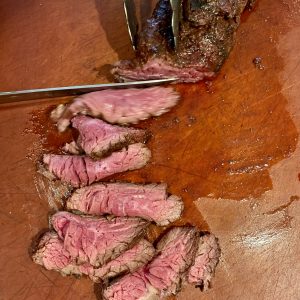
Always slice against the grain.
The grain refers to the direction the muscle fibres run.
Cutting across those fibres shortens them and creates a more tender bite.
Finish with flaky salt and cracked pepper right before serving.
Jody and Kirstie’s Hot Tips
- Salt early and generously
- Hold pepper until after grilling
- Pat steaks dry
- Create two heat zones
- Use a thermometer
- Pull steaks early because carryover cooking is real
- Rest larger cuts longer
- Slice against the grain
Substitutions
- Use avocado oil instead of olive oil
- Swap butter for compound butter
- Try fresh rosemary, thyme, or garlic during resting
- Experiment with marinades for leaner cuts
What to Know / Avoid
Do not grill cold steak straight from the fridge.
Do not repeatedly flip.
Do not press steaks with a spatula.
Do not slice immediately.
Do not guess temperatures.
Storage Recommendations
Store leftover steak refrigerated up to three days.
Slice thinly for sandwiches, tacos, salads, or grain bowls.
Cold steak from the fridge while standing at the counter is also a very real option, or for a delux breakfast, fry with eggs. Also perfect in our Fried Rice Recipe.
FAQ
Should I put pepper on steak before grilling?
We prefer adding pepper after cooking because high heat can make pepper bitter.
How long should steak rest?
Smaller steaks need about 5 minutes. Large cuts like tomahawks benefit from 10 to 15 minutes.
Do I need a thermometer?
Yes. Expensive beef deserves better than guessing.
Why are my steaks grey instead of browned?
Usually moisture or insufficient heat. Dry steak thoroughly and preheat properly.
What is the best steak for grilling?
Ribeye is our favourite combination of flavour, tenderness, and forgiveness.
Key Takeaways
- Salt early and skip pepper until the end
- Pat steak dry before grilling
- Pull steak below target temperature
- Resting dramatically improves results
- Slice against the grain for tenderness
If brisket feels like the graduate-level course of beef cookery, that is a whole other journey. Our brisket class walks you through the process from start to finish and turns a very intimidating cut into something approachable. You can check it out here: Brisket Class
About the Authors
Jody O’Malley and Kirstie Herbstreit are the Red Seal certified chef co-owners of The Culinary Studio in Waterloo, Ontario. Jody is a Stratford Chefs School graduate (2002) and Kirstie trained at SAIT in Calgary (2003). Together, they bring over 20 years of professional cooking experience and 15 years building one of Canada’s leading culinary education businesses.
Find it online: https://blog.theculinarystudio.ca/recipes/how-to-grill-steak/