Pickled Eggs: The Old-School Fridge Staple We’re Bringing Back

TL;DR: Pickled eggs are hard-boiled eggs soaked in a tangy vinegar brine with onion, garlic, mustard seed and peppercorns. Keep them refrigerated, give them at least 2 to 3 days to start absorbing the brine, and about a week if you want that proper pickled flavour all the way through.
There are certain foods that make us feel like we’re becoming our grandparents and pickled eggs are one of them!
After bringing homemade dill pickles back into our lives after a few years away from pickling, apparently we weren’t finished. Once you’ve got vinegar, jars and mustard seed scattered across the kitchen, there’s really only one direction to go. More things in brine.
Kirstie already refers to herself as Oma Jr., and both of us are Grammas in training. Feeding people, putting things in jars and making sure nobody leaves hungry feels increasingly like our natural habitat. This also came as a request from Jody’s husband!
But pickled eggs aren’t just old-school pub food or something you remember seeing in a giant jar at your grandparents’ house. They’re an incredibly useful thing to have in the fridge.
Eat one straight from the jar for the perfect high protein snack. Slice them onto toast. Quarter them into a salad. Turn them into very good devilled eggs. Add one to a snack plate when dinner somehow became crackers, cheese and whatever else you found in the fridge. We’ve even added them to our African Spiced Chicken Stew!

As Red Seal chefs, we’re also interested in what happens inside that jar. Why does vinegar preserve the eggs? How long does it take for the brine to penetrate? Why do some pickled eggs turn rubbery? Let’s make a jar and talk about it.
How Do You Make Pickled Eggs?
Pickled eggs are made by covering peeled, hard-boiled eggs with a vinegar-based brine and refrigerating them while they absorb the acidity and seasonings. The process is simple, but the eggs need time in the refrigerator for the brine to penetrate beyond the surface.
Here’s the basic process:
- Hard-boil the eggs (always use our tried and true method of carefully lowering the eggs INTO already boiling water).
- Cool and peel them.
- Make the vinegar brine.
- Add your aromatics and spices to clean jars.
- Put the peeled eggs into the jars.
- Completely cover them with brine.
- Refrigerate immediately.
- Let them pickle for 7-14 days before eating.
That’s it. No canner. No processing pot. And that’s important.
We are making refrigerator pickled eggs. Pickled eggs should not be home canned for room-temperature storage. Keep them cold.
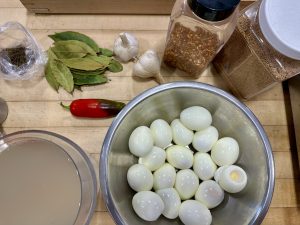
Our Classic Refrigerator Pickled Eggs Recipe
This is the kind of pickled egg we want in our fridge. Vinegary and savoury with just enough sugar to balance the acidity, plus mustard seed, peppercorns, onion and garlic.
This recipe is for 18 eggs, so you’ll need 3-4 500ml jars, depending on the size of your eggs, additions etc. Or use one giant jar.
- Prep Time: 20 minutes
- Cook Time: 10-15 min
- Total Time: 40 Minutes
- Yield: 2-3 jars 1x
Ingredients
- 18 large eggs
- 3 cups white vinegar, 5% acidity
- 1 1/2 cups water
- 1/2 cup granulated sugar
- 2 tablespoons kosher or pickling salt
- 3-4 cloves garlic, peeled and cut into thick slices
- 3 teaspoons mustard seed
- 1-2 teaspoons whole black peppercorns or chili flakes
- Bay leaves, optional
Instructions
-
Bring a large pot of water to a boil. Once boiling, gently lower the eggs into the water. Continue to boil gently for 10 minutes. Transfer the eggs immediately to a bowl of ice water. Let them cool completely.
-
Gently crack the shell all over and peel the eggs. If you need, peeling under a little running water can help get underneath the membrane. Try to keep the whites intact. A few divots aren’t the end of the world, but beautifully smooth eggs look better in the jar.
-
Make the Pickling Brine: Combine the vinegar, water, sugar and salt in a medium-sized pot.
-
Bring the mixture to a boil, stirring until the sugar and salt dissolve. Reduce the heat and simmer for 2 to 3 minutes.
-
Fill the Jars: divide the garlic slices, mustard seed, peppercorns or chili flakes and bay leaf, if using, amongst your clean jars.
-
Place the peeled eggs into the clean jar, gently though…If you’re squeezing that twelfth egg into the jar like you’re trying to close an overpacked suitcase, get another container. The brine needs to surround the eggs.
-
Add the Brine: Carefully pour the hot brine and aromatics over the eggs. Make sure the eggs stay completely submerged. Let the jar cool slightly, then cover and refrigerate promptly. Don’t leave the eggs sitting at room temperature for an extended period.
-
Let Them Pickle! You’ll notice flavour after a couple of days, but we prefer pickled eggs after about 7 days in the refrigerator. The longer they sit, the farther the brine travels into the egg white. It is recommended to eat within 1-2 months, if they last that long!
Notes
Why Pickled Eggs Need to Stay Refrigerated
Home pickled eggs belong in the refrigerator because there is no recommended home-canning method for making shelf-stable pickled eggs (this is where pickled eggs and our dill pickles go in completely different directions).
Acidified cucumbers can be processed using a tested boiling-water canning recipe, whereas eggs are different.
Even though we’re surrounding them with an acidic vinegar brine, acidity doesn’t instantly penetrate all the way to the centre of a hard-boiled egg.
The Science of Pickled Eggs
Pickling works through a combination of acidity, salt, time and refrigeration. The vinegar brine gradually moves into the cooked egg white while flavour compounds from the spices and aromatics move along with it.
The egg doesn’t suddenly become “pickled” the second you pour vinegar over it as the brine moves gradually from the exterior toward the centre. If you cut open an egg after one day, you’ll mostly taste the brine around the outside. Give it several more days and the flavour becomes much more pronounced throughout the white.
Why Does Vinegar Change the Texture?
Egg whites contain proteins that have already been transformed by heat during cooking, then we introduce acid.
The acidic brine interacts with those proteins and changes the texture further. Over time, the whites can become firmer.
How Long Do Pickled Eggs Need to Pickle?
Small and medium eggs can develop noticeable pickled flavour within several days, but we prefer giving large eggs about a week before eating them. The brine needs time to penetrate.
At 2 to 3 days, you’ll get a lightly pickled egg.
At 5 to 7 days, you’re getting much closer to what we think of as a proper pickled egg.
After that, the flavour continues to intensify. If you’re making them for a party or weekend gathering, make them about a week ahead. More often, ‘food gifts’ are becoming very popular! We’ve got a friend that always gifts a giant steak from Fore Quarter Butcher Shop for a Christmas Gift Swap!
Jody and Kirstie’s Hot Tips
- Use slightly older eggs. They often peel more easily than eggs that came straight from the farm yesterday.
- Cool them quickly. An ice bath stops the cooking and helps prevent that grey-green ring around the yolk.
- Use 5% acidity vinegar. Check the bottle.
- Keep the eggs submerged. The brine should completely surround them.
- Give them time. We like about 5 to 7 days before cracking into the jar.
- Don’t boil the eggs into submission. Overcooked eggs already have firm whites. Add an acidic brine and you’re headed toward rubber-ball territory.
- Write the date on the jar. It takes two seconds and saves you from playing “When did we make these?” three weeks later.
- Make devilled eggs with them. Seriously. Pickled devilled eggs are excellent.
How to Make Easy-to-Peel Hard-Boiled Eggs
The easiest pickled eggs are the ones you can peel without destroying half the white. Very fresh eggs can sometimes be more difficult to peel because the inner membrane clings tightly to the white.
Slightly older eggs often peel more easily.
Our other advice? Slowly immerse the eggs into already boiling water. Our favourite tool for this is the Asian Spider. When an egg hits boiling water, the proteins in the outer egg white coagulate quickly. That rapid blast of heat helps the white set before it has as much opportunity to bond tightly to the thin membrane just inside the shell. The result is often a shell and membrane that release more cleanly when you peel the egg.
Then quickly removed to an ice bath or cold running water after 10 minutes, and your peels will slip right off!
[caption id="attachment_907" align="aligncenter" width="300"]
 One of our favourite kitchen tools![/caption]
What Can You Add to Pickled Eggs?
Once you understand the basic refrigerator method, you can have some fun with the flavour profile. This is where pickled eggs get interesting!
Beets
Add cooked or pickled beets and you’ll get those gorgeous pink pickled eggs. The colour gradually works its way from the outside toward the yolk. Slice them in half and they look fantastic on a platter.
Fresh Dill
If you’ve just made our dill pickles and have dill heads left over, toss some into your egg jar. Very efficient. Very Oma Jr.:)
Chili Flakes
Add a pinch of red pepper flakes if you want some heat.
Jalapeño
A few jalapeño slices give the brine a fresh chili flavour and gradually add heat to the eggs.
Pickling Spice
A prepared pickling spice blend gives you a more old-fashioned, aromatic pickled egg. Just remember that some blends contain cloves and cinnamon, which can become dominant quickly.
Substitutions
Pickled eggs are flexible when it comes to flavour, but we still want a strongly acidic brine and proper refrigeration.
Can I Use Apple Cider Vinegar?
Yes, provided you’re using vinegar with 5% acidity. Apple cider vinegar gives the eggs a slightly fruitier flavour and darker colour than distilled white vinegar.
Can I Use Red Onion?
Absolutely. Red onion adds flavour and can give the brine a slight pink hue over time.
Can I Use Honey Instead of Sugar?
For refrigerator pickles, you can adjust the sweetener to taste. Honey will bring its own flavour, so start conservatively.
Can I Leave Out the Sugar?
Yes. The sugar balances the sharpness of the vinegar, but these are refrigerator pickles rather than a shelf-stable canned product. Leaving it out will give you a sharper, more aggressively vinegary egg.
What to Know and Avoid With Pickled Eggs
Pickled eggs are easy, but there are a few rules we don’t mess around with.
Do not home-can pickled eggs.
There is no recommended home-canning process for shelf-stable pickled eggs. Store them in the refrigerator.
Also avoid:
- Leaving pickled eggs sitting at room temperature
- Using cracked or questionable eggs
- Packing the jar so tightly that brine can’t surround the eggs
- Assuming vinegar instantly makes the centre of the egg acidic
- Keeping a jar indefinitely because “it’s pickled”
- Reusing old brine over and over
- Eating eggs from a jar that smells, looks or behaves suspiciously
Pickling extends the useful life of food. It does not grant immortality.
How to Store Pickled Eggs
Keep homemade pickled eggs covered and refrigerated at 4°C or colder.
According to current home food-preservation guidance, properly prepared refrigerator pickled eggs can generally be stored refrigerated for up to 3 to 4 months, although we think the texture is best well before that point.
Always use clean utensils to remove eggs from the jar. Don’t reach in with your fingers. Use a spoon to gently haul them out of the jar.
Can You Reuse Pickle Brine for Eggs?
We don’t recommend repeatedly reusing old pickle brine to preserve batches of eggs.
Once a brine has been used, food has released water and other compounds into it. Its composition isn’t necessarily the same as the fresh brine you started with.
If you have leftover dill pickle brine and want to drop a couple of hard-boiled eggs into it for a quick refrigerator experiment, that’s one thing, but for a proper batch, make fresh brine.
Vinegar is cheap, twelve eggs are not. Protect the eggs.
What to Serve With Pickled Eggs
Pickled eggs are basically the ultimate refrigerator snack, but they’re also surprisingly useful in meals.
Try them:
- Halved with salt and pepper
- On a charcuterie or snack board
- Sliced over avocado toast
- Quartered into a green salad
- With potato salad
- Alongside smoked fish
- With crusty bread and cheese
- In a grain bowl
- Turned into egg salad
- Turned into devilled eggs
- Added to a tomato & spice rich stew at the end
Pickled Eggs FAQ
How long before pickled eggs are ready to eat?
You’ll notice some pickled flavour after 2 to 3 days, but we prefer waiting about 7-10 days for large eggs so the brine has more time to penetrate the whites.
How long do homemade pickled eggs last?
Keep homemade pickled eggs refrigerated at 4°C or colder. Current home-preservation guidance allows refrigerated pickled eggs to be stored for several months, although their texture and flavour will change over time.
Do I need a pressure canner for pickled eggs?
No. Homemade pickled eggs should not be pressure canned or water-bath canned. There is no tested home-canning method for shelf-stable pickled eggs. Make them as refrigerator pickles instead and keep them refrigerated at 4°C (40°F) or colder.
Can you can pickled eggs for pantry storage?
We don’t recommend it. Health Canada advises home canners to use only current, tested canning recipes and processing methods. We could not find a tested Canadian home-canning method for pickled eggs, so our recipe is strictly a refrigerator pickle. Keep your pickled eggs refrigerated at 4°C (40°F) or colder.
Do pickled eggs have to be refrigerated?
Yes. Homemade pickled eggs should remain refrigerated. There is no recommended home-canning method for making shelf-stable pickled eggs.
Can you can pickled eggs in a water bath?
No. Do not use a boiling-water canner to make shelf-stable pickled eggs. Make refrigerator pickled eggs instead and keep them cold.
Why are my pickled eggs rubbery?
Overcooking the eggs and leaving them in a strong acidic brine for a long time can both create firmer, eventually rubbery whites. Start with properly cooked eggs and enjoy them while the texture is still good.
Why did my egg yolks turn grey?
A grey-green ring around a hard-boiled yolk usually comes from overcooking or cooling the egg too slowly. It isn’t caused by the pickling process itself.
Can I make pickled eggs with leftover pickle juice?
You can use leftover pickle juice to flavour a few refrigerated hard-boiled eggs, but we prefer making fresh brine for a full batch so we know exactly what’s in it.
Can I make spicy pickled eggs?
Absolutely. Add chili flakes, sliced jalapeño or another fresh chili to the refrigerator brine. Start with less than you think. Chili heat continues to infuse while the eggs sit.
Key Takeaways
- Pickled eggs are hard-boiled eggs refrigerated in a vinegar-based brine with spices and aromatics.
- Give large eggs about 7 days for a good pickled flavour.
- Keep homemade pickled eggs refrigerated at 4°C or colder.
- Do not home can pickled eggs for pantry storage.
- Make a fresh brine, keep the eggs submerged and don’t overcook them if you want tender rather than rubbery whites.
If you like understanding why recipes work instead of simply following instructions, listen to our Chef Over Your Shoulder podcast, where we get into the science, techniques and very strong opinions behind what we cook.
About Jody and Kirstie
Jody O’Malley and Kirstie Herbstreit are the Red Seal certified chef co-owners of The Culinary Studio in Waterloo, Ontario. Jody is a Stratford Chefs School graduate (2002) and Kirstie trained at SAIT in Calgary (2003). Together, they bring over 20 years of professional cooking experience and 15 years building one of Canada’s leading culinary education businesses. They teach home cooks the science and techniques behind great food, not just the recipes, and co-host the Chef Over Your Shoulder podcast alongside Amy Schlueter.
Find it online: https://blog.theculinarystudio.ca/recipes/pickled-eggs/